
Eats, Streets, and bEEts:
A New Model Pediatrics Conference aimed at Early Career Trainees and Patient Communication
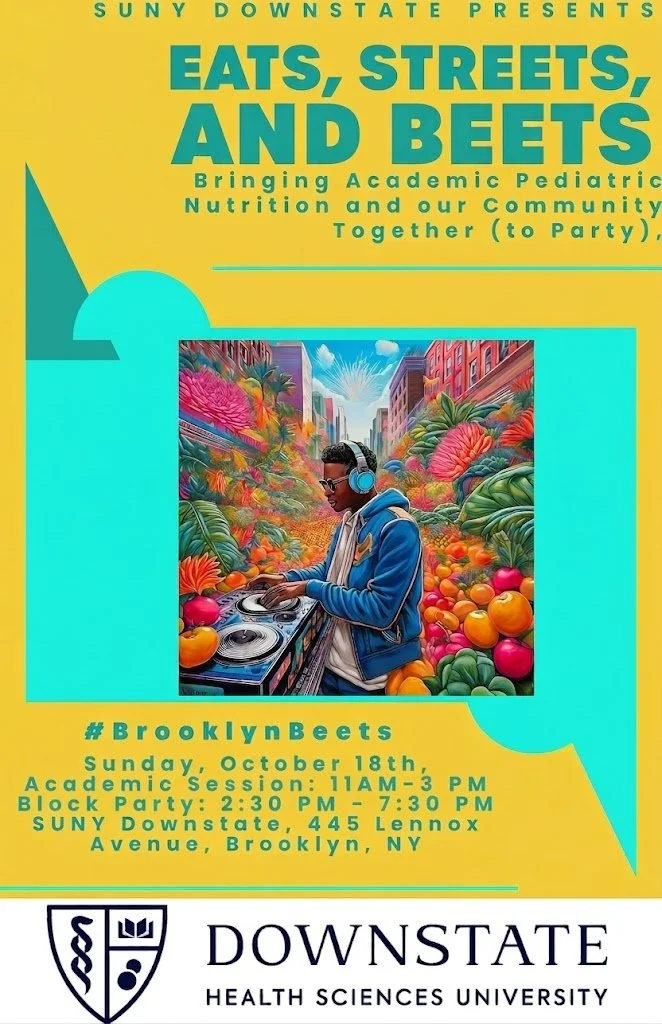
In the current moment, a mixture of disinformation, gaps in science and healthcare communication, and varying food quality have met massive advances in our understanding of how diet impacts health. To further develop the communication skills of our trainees, highlight current work from our brilliant group of future pediatricians and pediatric specialists, and empower our community to use this new wealth of information, SUNY Downstate hosts an annual pediatric conference aimed at trainee physicians and physicians-in-training, with the goal of driving interest in research, research communication skills, and medical communication skills. All abstracts will have podium presentations, registration is free, submission is free, just come and hang out!
The program will be comprised of 2 Sessions:
(1) The Academic Session will begin with a keynote speaker lunch program focusing on hot topics or research with direct applications to quality of life. Last year we discussed avoiding food allergies, foods that support skin health, and how to handle a picky eater. Following, conference attendees will present their research through brief oral presentations in breakout sessions, with all accepted abstracts receiving a podium talk.
(2) The Community Engagement Session/Resource Fair will feature trainees’ communication abstracts that explain complex nutritional concepts in simple, easy-to-understand ways for the public. The winners of these communication abstracts will have the opportunity to present their work during set breaks between live music performances by musicians and DJs at the community fair event. Local agencies and health services will be on site, as well as exhibitors from sponsors, including interactive training tools for healthcare trainees.
Abstracts: two formats are available, research abstracts and communication.
a) Research abstracts must include original research or original QI, although case reports with summative research (ie, a systematic review) are acceptable. Research must be pediatric or apply to pediatrics, but can cover all topics (although as a program run by a peds GI, we do love nutrition and GI questions). PDF or Word doc files are acceptable, but abstracts must fit on a single page, using 11 point font and margins of 0.5 or more.
b) Communication abstracts are intended as an exercise in improving physician communication skills. Like QI, the goal is to start from a known thing, but instead of figuring out how to apply it at our practice, we are figuring out how to communicate it to patients. The limitations for this abstract class are broad, we will accept any written, visual, or recorded form of a communication effort, which could be used as a flyer, mailer, poster, or social media post. These abstracts will seek to break down a complicated topic with a clear application (ie, low glycemic index diet), to make it easily understandable for the general population. We would love to see creativity in this, and encourage participants to think broadly, read up on communication research, and give us their best shot!
c) Awards: three awards (the coveted Golden Beet) will be given out, for:
Best presentation: Judged by faculty on fluency, understanding of the material presented, presentation quality, and communication efficacy.
Best original research: Judged based on execution of research. The winning abstract is not necessarily the most impactful, but the one most cleanly executed.
Best communication abstract: Judged based on faculty scoring of efficacy in communication at an appropriate language level.
d) Timeline: Abstract submission is now open, with final submissions deadline extended to 10/2!